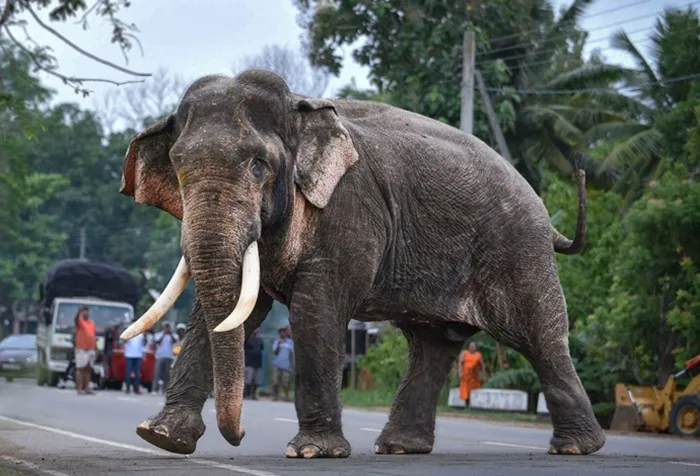
Kawanthissa, also written Kavantissa, died at about 6.18pm on 16 October 2026, in a paddy field near Galgamuwa, with wildlife veterinarians still working on him. He was widely regarded as the largest and tallest wild tusker in Sri Lanka.
He never came near the parks we work in. His range was two districts away. We are writing about him anyway, because there is no honest version of being an elephant safari operator in this country that treats his death as somebody else’s news.
This piece reflects what was reported as of 17 October 2026. The post-mortem had not yet been completed when we published it, and the official cause of death was not established. We have linked the reporting so you can check it and follow it yourself.
Who he was
Kawanthissa was first sighted in 2008 and given his name in 2015, after King Kavantissa of Ruhuna, father of Dutugemunu. It is a heavy name to hand an animal, and by most accounts he carried it.
He came to national attention in 2012, after the death of the Siyambalangamuwa tusker, who had held the unofficial title before him. From then on he was the elephant people drove out to see.
What was reported about him:
- Believed to be between 50 and 60 years old.
- Around 11 feet tall. Mongabay put it more conservatively at over three metres.
- Tusks more than six feet long, reported to be second in size only to those of the late Siyambalangamuwa tusker.
- He ranged across Galgamuwa, Usgala, Ambanpola and Siyambalangamuwa, in Kurunegala District in the North Western Province.
One detail comes up in nearly every report, and it is the one worth sitting with. In roughly five decades of moving through farmland, villages and paddy, he was never known to have killed or injured anyone.
What happened to him
In September 2026 a wound was found on his right front leg. It was believed to have been caused by a gunshot. The Department of Wildlife Conservation began treating him on 24 September.
Officials said the wound itself appeared to be healing. What did not improve was his condition. He stopped eating, became dehydrated, and weakened over the following weeks. He was eventually found collapsed in the Siyambalangamuwa area, and he died during treatment on 16 October. A small number of reports give the date as 15 October, but 16 October is the date most sources agree on.
Nobody has been publicly identified as having shot him.
Why a tusker is not simply a large elephant
This is the part most visitors do not know, and it is why the loss registers the way it does here.
Tusks are not horns. They are elongated upper incisors, rooted in the skull, and in elephants that grow them they keep growing throughout life. A six foot tusk is not a feature an animal is born with. It is five decades of uninterrupted growth, which is why the biggest tuskers are always old animals and why they cannot be replaced on any timescale that means anything to a person.
The Sri Lankan elephant, Elephas maximus maximus, is the largest of the Asian subspecies. But only a small minority of Sri Lankan males grow tusks at all. The commonly cited figure is around seven per cent, though published estimates vary somewhat. Set that against roughly 45 per cent of bull elephants in North India and about 95 per cent in South India, and the scale of it is clear.
Why so few is genuinely contested. Some researchers suspect a genetic peculiarity in the island population. The elephant biologist Prithiviraj Fernando points instead at history: for centuries tuskers were the ones captured out of the wild, for temples, for ceremony, for work. Removing them generation after generation is artificial selection, whether anyone intended it or not, and what it selects for is tusklessness.
Fernando also makes a point that cuts against sentimentality, and we think it is worth including. He argues that tuskers matter chiefly as flagship symbols, not because any single individual is biologically irreplaceable. The grief is real, but the conservation case rests on what the attention is used for.
Why a leg wound kills an animal that size
The thing that puzzles people reading the reports is how an apparently healing wound ends in death.
Scale is most of the answer. A mature bull of Kawanthissa’s dimensions carries several tonnes, and a large share of that load sits over the forelimbs. An injured foreleg cannot be rested the way a smaller animal rests a limb. Every step, every shift of weight, every attempt to reach food and water goes back through it. An injury that would be minor in a smaller animal becomes a mobility problem, and a mobility problem in a wild elephant becomes a feeding and drinking problem.
That is consistent with the sequence officials described: a wound that looked better, an animal that stopped eating, dehydration, and a decline that treatment could not reverse. We should be careful here, though. The post-mortem had not been completed when we wrote this, and the official cause of death was not yet established. Treat the above as the general physiology, not as a conclusion about this animal.
This is also the backdrop to an argument that has been running in Sri Lankan conservation circles since the tusker Bhathiya died in July 2025, immobilised by multiple gunshot wounds, after weeks of suffering. That case reopened a hard question about whether euthanasia should be on the table when veterinarians judge recovery unlikely. It is not a comfortable debate. It is a real one.
What is being done now
As of 17 October 2026:
- The Department of Wildlife Conservation moved to obtain a court order to carry out a post-mortem on the remains.
- A panel of experts, including specialists from the University of Peradeniya, is to examine the body and determine the cause of death.
- Opposition Leader Sajith Premadasa paid his respects and called for an independent and transparent investigation involving both local and international experts.
- The environmentalist Nayanaka Ranwella has called for an independent examination of the remains and a separate inquiry into who fired the shot.
What has not been reported, at least not in anything we could verify, is any decision about what happens to his tusks. There is speculation circulating about that. Speculation is all it is, and we are not going to repeat it as though it were reporting.
He was not the first
This is the part that turns a sad story into a pattern.
Unicorn, one of the best known tuskers of the Minneriya region, was found shot dead in March 2025. Koliya, a young tusker, was shot in 2024, and his decomposed body was found that December. Bhathiya died in July 2025. The wildlife photographer Namal Kamalgoda described the big tuskers of Sri Lanka as falling like dominoes, and it is difficult to read the past two years any other way.
One honest qualification, because it matters. A Mongabay analysis of Department of Wildlife Conservation records found that total elephant deaths in 2025 were not unusually high: 245 by the end of July, against 257 and 260 over the same period in 2022 and 2023. The overall death toll is not spiking. What alarms people is narrower and harder to measure, which is that the named, photographed, decades old tuskers keep turning up shot. Suspicion of organised ivory poaching exists. It has not been substantiated.
What this has to do with a safari company in Sigiriya
A fair question, and we would rather answer it than pretend there is no commercial context to a company publishing this.
Mongabay’s recent reporting carries an argument we think is correct. It is unreasonable to expect a single state agency to carry responsibility for the country’s wildlife on its own, without a policy framework that lets communities, conservation organisations and the private sector act as genuine partners. Safari operators are part of that private sector. We drive into these parks for a living.
In practice, for us, that means the things we already say on our ethics page and intend to keep doing: holding distance, engines off at sightings, never crowding or pursuing an animal for a better photograph. None of that would have saved Kawanthissa. He was shot in farmland, far from any park gate, and the pressures that killed him are not tourism pressures. But an industry that treats elephants as a backdrop to be driven at is in no position to ask anyone else to value them.
If you want to understand the animals you are coming to see, our wildlife guide covers what lives in the parks around Sigiriya and how often it is actually seen. Fewer than one male in ten here will ever carry tusks. If you see one, you have seen something uncommon.
Kawanthissa was about fifty years old, and somebody shot him in the leg. That is the whole of it.
Sources
Newswire: Sri Lanka mourns loss of iconic tusker Kawanthissa, Daily Mirror: Iconic tusker Kavantissa dies while receiving treatment, News First: Expert panel from Peradeniya University to determine cause of death, OnLanka: Wildlife Department to seek court order for post-mortem, Newswire: Sajith pays last respects, calls for foreign experts, Mongabay: Sri Lanka elephant found with a gunshot wound, Mongabay: Sri Lanka’s iconic tuskers falling like dominoes, Mongabay: Tusker death sparks euthanasia debate, Mongabay: Data debunks spike in elephant killings, Daily News: Kavantissa, the elephant with a humane heart